The Causal Budget: Mechanics of Motion and Time Dilation
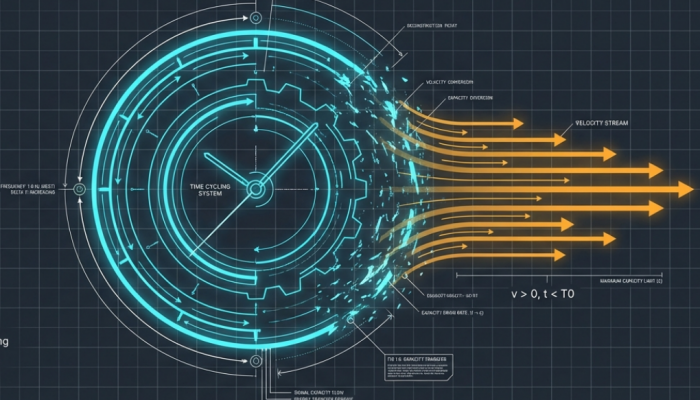
Moving clocks must slow down because they are physical structures maintained by internal signals that have a fixed speed limit (c). When the clock moves, it must “spend” some of that limited signal speed just to keep its moving parts connected, leaving less speed available for the internal ticking mechanism.
Here is the step-by-step mechanical explanation of why causal closure forces this slowdown.
1. The Finite “Causal Budget”
In DEF, a clock (like an electron or an atom) is not a solid object; it is a closed circulation of the expansion field. For the clock to exist, signals must constantly travel around its internal loop to keep it synchronized (“closed”).
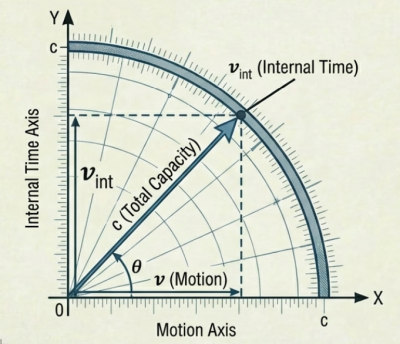
There is a strict limit on how fast these signals can travel: the universal causal speed, c. This creates a zero-sum “causal budget” for the object:
• Internal Circulation (vint): The speed used to cycle the clock (ticking).
• Translation (v): The speed used to move the whole object through space.
Since the total signal speed cannot exceed c, these two must share the budget according to the partition rule: vmotion2+vinternal2=c2
2. Motion “Tax” on Internal Cycles
When the clock is at rest (v=0), 100% of the causal capacity is available for internal circulation. The clock ticks at its maximum possible rate (vinternal=c).
When the clock moves (v>0), part of its causal capacity is necessarily diverted to maintaining translational coherence. Effectively, the internal signals have to “chase” the moving boundaries of the electron to keep it intact.
• Because some of the fixed budget c is now used for motion, vinternal must decrease.
• A lower vinternal means the circulation completes fewer loops per second.
• Fewer loops = a slower clock.
3. Why Closure Would Fail Without Slowing
You asked why it must slow down. If a clock tried to move at velocity v without slowing its tick rate, it would require its internal signals to travel at c2+v2 (faster than light) to complete the cycle on time.
Since superluminal signaling is impossible in DEF, the only way to preserve the object’s existence (its “causal closure”) is for the internal cycle to take longer.
4. The Role of Length Contraction
To ensure this closure works geometrically, the clock must also shrink.
• Signals sent forward inside the clock have to chase the front edge, which is moving away.
• Signals sent backward meet the rear edge quickly.
To keep these round-trip times consistent with the slower clock rate, the clock physically shortens along the direction of motion. This length contraction ensures that the slower internal signals can still make it around the loop and close the cycle successfully.
Summary
Moving clocks slow down not because “time” changes abstractly, but because motion consumes causal capacity. To preserve the causal closure of the physical structure without exceeding the speed limit c, the internal cycling rate must drop by exactly the Lorentz factor needed to balance the budget.